

Indoor Air Quality – How I Made the Air I Breathe Healthier By Using NASA Research

Some of you may be wondering why I said in my first post that I’d rather have house plants than an air purifier.  I chose house plants because they do not use any energy other than sunlight, and because my research did not convince me that air purifiers were significantly better than houseplants.  Thus, I preferred the cheaper, more natural option.

What I said in the previous post:

To me, [naturopathic self-healing] means utilizing evidence-based natural solutions when possible, such as using house plants to improve the quality of the air in my house, rather than buying an air purifier.

The Spousal Unit and I had talked for years about getting an air purifier.  We thought that putting an air purifier in the bedroom would help us get better sleep.  I had read blogs and websites written by asthmatics and allergy sufferers who highly recommended air purifiers with HEPA filters, and they were pretty persuasive.  The only thing holding me back was the price – $500+ for a one-room HEPA filter air purifier.

“Maybe I could start with something less expensive,” I thought.  “What about those Himalayan salt lamps?”  According to the advertisements, a Himalayan salt lamp “works as an air purifier by emitting negative ions into the air.”  And they retail for $25-$30 for a smaller lamp.  So I did some research.  Unfortunately, I found that Himalayan salt lamps do not emit negative ions in a large enough quantity to have an actual effect on your indoor environment.  For a thorough examination of Himalayan salt lamps, I recommend this post over at A Breath of Reason blog.  Bottom line: they don’t improve air quality.

Ok, what about beeswax candles?  They are also touted as being good for air quality because they release negative ions.  Nope, Skepticcystic over at A Breath of Reason debunked beeswax candles too.  (See this post.)  According to her research, not only do beeswax candles not release stable negative ions, but there is no scientific evidence that beeswax is healthier to burn than other types of wax.  So, although some would argue that you should avoid the phthalates in artificially scented candles, the type of wax  a candle is made of doesn’t appear to make a difference to indoor air quality.  Bottom line: Regardless of what they are made of, burning candles does not improve indoor air quality.

So back to air purifying machines…

For a practical overview of air purifiers, check out this article from ConsumerReports.  For example, ConsumerReports suggests:

“Before you buy an air purifier, try some simple, common-sense steps to reduce indoor air pollution. Begin by vacuuming often, banning smoking indoors, minimizing use of candles and wood fires, and using exhaust fans in kitchen, bath, and laundry areas.”

As the article continues, various claims made by air purifier companies are tested.  ConsumerReports cautions that ozone-producing air purifiers are actually harmful to your health and should be avoided, particularly if you have allergies or breathing problems.  This is confirmed by the American Academy of Asthma Allergy & Immunology:

There is no debate about the negative effect of ozone…with the FDA concluding there is no place for ozone in medical treatment.” (See article here.)

For more information on the pros and cons of air purifiers, read this article from the New York Times, in which Steven Kurutz, an allergy sufferer, tested six popular air purifiers.  Here are a few excerpts from his article:

“For all their high-tech wizardry (some claim to be able to eliminate particles 0.3 microns in size and smaller), air purifiers occupy the same category as faith-based wellness products like nutritional supplements.”

And,

“Over the years, the Federal Trade Commission has taken action against several makers of air purifiers, including brands like Honeywell and Oreck, for unsubstantiated allergy-relief claims or for advertising that their devices removed virtually all impurities from the indoor air people breathed.”

According to ConsumerReports’ deputy home editor, Celia Kuperszmid Lehrman, whom Kurutz interviewed for the article,

“The first thing you need to know about an air purifier is that most people don’t need one.”

However, some doctors do recommend air purifiers for their patients, particularly children who suffer from asthma.  So, if you have asthma or allergies (or both), talk to your doctor about whether an air purifier would be beneficial for you.

According to the American Academy of Allergy Asthma & Immunology:

There is no definite evidence of filtration clinically benefiting patients with allergic disease, but this may be the result of the studies being of insufficient durations to prove benefit.   The best review of the topic is by Sublett et al in 2010, a report of the Indoor Allergen Committee of the American Academy of Allergy Asthma and Immunology.” (See AAAAI article here.)

The Bottom Line for Air Purifiers: The different things you may be allergic to (dog allergens, cat allergens, mite allergens, mold, pollen, etc.) have different-sized particles.  You will see the most benefit if you select an air purifier that is designed to filter the particle size of the allergen that most affects you.

Conclusion from the Sublett et al report:

“As far as optimal choice of cleaning devices, initial cost and ease of regular maintenance should be considered. Portable room air cleaners with HEPA filters, especially those that filter the breathing zone during sleep, appear to be beneficial.

For the millions of households with forced air HVAC systems, regular maintenance schedules and the use of high-efficiency disposable filters appear to be the best choices.

However, further studies and research in this area are desirable to make more definitive recommendations in the role of air filtration on improving disease outcomes.”

Ok, so I could buy an expensive HEPA filter air purifier for my bedroom, which might help us sleep a bit better.  Are there any other options?

That’s when I remembered that house plants help improve indoor air quality.

Most of us learned in school that plants breathe in carbon dioxide and breathe out oxygen (roughly speaking), which is great for humans because we breathe in oxygen and breathe out carbon dioxide.  So having plants in the house helps increase the oxygen level in the air and decrease the carbon dioxide level.  But indoor plants can do more than just produce oxygen.

NASA published research in 1989 which demonstrated that house plants help reduce indoor air pollution.  Due to the energy crunch in the 70’s, buildings became more air-tight to reduce energy costs associated with escaping heated or cooled air.  But then occupants began developing health problems, and researchers determined that decreased air flow in buildings led to higher concentrations of carbon dioxide and volatile organic compounds (VOCs) in the indoor air.

Three of the VOCs NASA focused upon in its research were benzene, tricloroethylene, and formaldehyde.  These chemicals pose various health hazards that range from skin and eye irritation to headaches, asthma, and cancer (pp. 3-5).  Assuming we’d like to avoid these health hazards, what can we do to reduce the levels of these chemicals in our homes?

As NASA points out, “The first and most obvious step in reducing indoor air pollution is to reduce off-gassing from building materials and furnishings before they are allowed to be installed.” (p.2)

The best way to reduce chemical indoor air pollution is to choose lower-VOC or zero-VOC options for furnishings, floorings, and other elements inside your home (wall paint, flooring glues, shower curtains, etc).  That way, you’re bringing less VOCs into your house to begin with.  (There are lots of good articles about this on the web; I encourage you to Google-Fu them.)

In addition to reducing VOCs by using less-toxic cleaning supplies, lower-VOC paint, etc., we figured “If it’s good enough for NASA, it’s good enough for us,” and bought houseplants – lots of houseplants.

Before I bought the plants, I did an online search and found many helpful articles.  This article at Lifehacker.com has a graphic of various houseplants and the chemicals they filter best.  And since houseplants have not fared well at my house in the past, I also read articles, including this one, on low-maintenance, hardy houseplants.  See this article for a good overview of the benefits of houseplants, including how many you need per room/ per square foot.

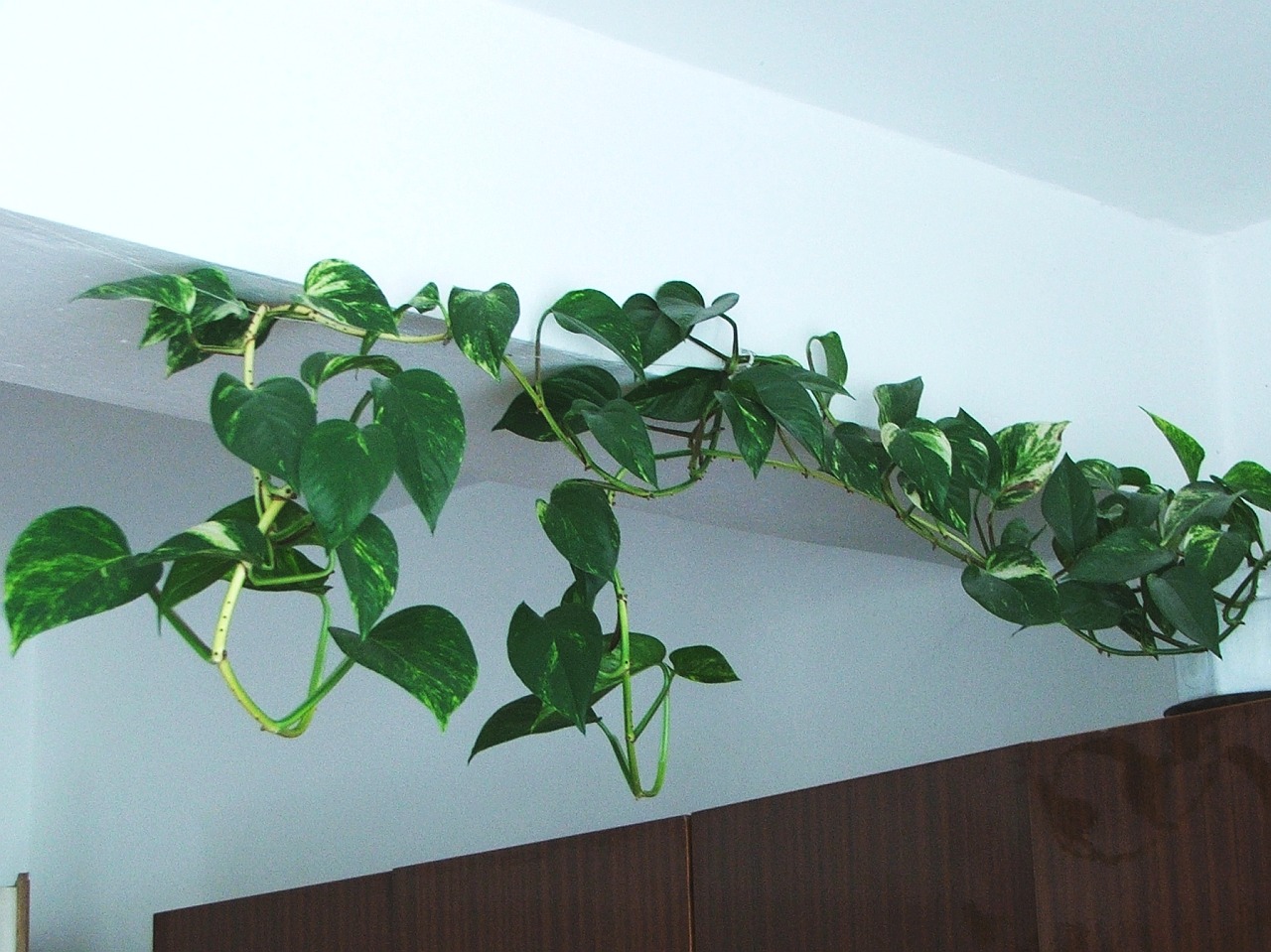
In the end, I decided to buy plants that didn’t have runners that would wind up all over the house (I’m looking at you, golden pothos).  I found a local nursery and selected plants for various rooms based on the available sunlight in those rooms, the amount of available space, and what looked good to me.  Be sure to check how big each plant typically grows, so you don’t buy ones that will outgrow the space you bought them for.

For the bedroom, I selected a snake plant (a.k.a. mother-in-law’s-tongue; see picture at top of post) because they are one of the only plants that continue to take in carbon dioxide and give out oxygen at night.

So far, it’s been about six months and none of the houseplants has died.  In fact, nearly all of them are thriving.  It’s hard to say whether our indoor air quality has improved, since we don’t have a way to test it.  But at least we know that science is on our side, and we didn’t waste our money on air purification myths like beeswax candles or salt crystal lamps.

CAUTION: Many low-maintenance houseplants are toxic to dogs, cats, and sometimes children if they chew on the plants.  If this is likely to happen in your home, make sure you know which plants are toxic, and put them where pets or children cannot reach them.


Health Hack: Morning Checklist

The military loves checklists.  For some career fields, it feels like there’s a checklist for every action except going to the can/head/toilet. (Number 1 – check.  Number 2 – check.)

For many of us veterans, using checklists has become a deeply ingrained habit pattern.  So why not harness the checklist habit pattern and utilize the checklist tool to create a healthier lifestyle?

Particularly if you have a health condition that affects your memory, thought-process, or motivation, a checklist can be a very helpful aid.  Why not use  checklists as a health life hack? (“Life hacking refers to any trick, shortcut, skill, or novelty method that increases productivity and efficiency, in all walks of life.”)

Research indicates that it is often beneficial to take positive actions whether or not we “feel like it”.  Since I frequently wake up feeling crappy and either forget to accomplish some or most of my morning routine or just don’t feel like doing it – but I know that my morning routine is good for my health & wellbeing – I have decided to implement a morning checklist.  While it’s easy to destroy my morning routine by gradually skipping more and more days, it’s much more difficult for me to intentionally not accomplish the checklist.  So, for me, routine checklists are an effective life hack.

This is my Morning Checklist:

Morning Health Checklist – One Sick Vet

(Feel free to print it out and use it, or create your own.)

You could also use a daily health journal, a spread sheet, or a chart (like a kid’s chore chart) on the wall or refrigerator or bathroom mirror.  Whatever works for you.  (Anyone know of an app for that?)  The key is to find a way to get yourself to consistently make healthy choices and take healthy actions whether or not you feel like it, or to find a method that helps you remember when you are having difficulty remembering.

What will you do to hack your health today?

Medical Procedures: What It’s Like To Get An EMG (Electromyography)

Raise your hand if you’ve got a bad shoulder (badum ching!).  Yup, me too.  Although I had surgery to repair it a year ago, I’ve had some lingering problems.

Since physical therapy (PT) hasn’t resolved the functionality problems with that arm, my primary care manager (PCM) ordered some diagnostic medical procedures to try to determine what’s causing the problems.  One of the procedures that was ordered was an electromyography.

Electromyography (EMG) is a diagnostic procedure that assesses the health of muscles and the nerve cells that control them (motor neurons).  According to the Mayo Clinic,

“Motor neurons transmit electrical signals that cause muscles to contract. An EMG translates these signals into graphs, sounds or numerical values that a specialist interprets…EMG results can reveal nerve dysfunction, muscle dysfunction or problems with nerve-to-muscle signal transmission.”

In my case, they were trying to determine whether a pinched nerve in my neck was causing the problems with my arm.

Electromyography is an outpatient procedure that typically takes about an hour.  EMG is often done in conjunction with a nerve conduction study (NCS), which I also had.  NCS is the measurement of “the speed of conduction of an electrical impulse through a nerve. NCS can determine nerve damage and destruction” (Johns Hopkins).

According to WebMD,

“Nerve conduction studies are done before an EMG if both tests are being done. Nerve conduction tests may take from 15 minutes to 1 hour or more, depending on how many nerves and muscles are studied.”

Since they were going to need access to my arm and shoulder (and trapezius, as it turned out), I wore a track suit with a tank top underneath. They asked me to take off the track suit jacket and lie down on an examining table.

To prepare for the NCS, the person administering the torture procedure asked me to move my fingers, hand, and arm in several different directions so she could determine her targets.  These she marked on my arm with a marking pen.  She fastened several electrodes to my hand and fingers with tape (see picture below), and proceeded to zap me with a machine that looked like a taser (but used less voltage, obviously).


This is not a pleasant sensation.  It typically wasn’t too painful, except when she applied multiple shocks in the same location.  The second or third consecutive shock in the same spot became more and more painful.  For the most part, she told me what she was going to do before she did it, which helped me prepare.  When she told me she needed to do 10 shocks in the same place, I knew two things: 1) It was going to hurt like hell, and 2) I’d better do the stress management/relaxation breathing techniques I learned at the base Wellness Center.

Breathing techniques, whether learned through biofeedback training or as part of yoga or meditation can be very helpful for managing pain or stress.  I use them whenever I am having an uncomfortable/painful/stressful medical procedure.  Of course, in this case, relaxing was a bit more challenging, since my body was also jerking from the shocks.  For some of the shocks, only my hand/wrist twitched.  But for some of them, my opposite leg jumped.  Several times I got a cramp in my arm muscles, and toward the end, I got a cramp in the muscles in my lower back.

That was part one.  Part two was the EMG.  “During a needle EMG, a needle electrode inserted directly into a muscle records the electrical activity in that muscle” (Mayo Clinic).

The needle is inserted into various muscles.  It didn’t hurt most of the times it was inserted, since it is a very fine needle.  It did hurt when it was inserted into the trapezius muscle.  Once it is inserted, the doctor taps on the needle, and sometimes moves it around inside the muscle as she listens to the signal.  As you can imagine, this doesn’t feel very good.  Then she asks you to engage the muscle.  You can hear an increase in signal noise while you are engaging the muscle.  This also doesn’t feel very good, as the needle feels like it is stabbing you more.

These tests may be done only on one side of your body (one arm, one leg, etc.), or they may be done on both sides of your body in order to compare results.  In this case, they only tested the problematic arm, not both, and the doctors were able to give me my results at the end of the procedures.

The good news is they didn’t see any evidence that I have a pinched nerve in my neck.  The bad news is that these diagnostic procedures didn’t help determine the cause of the problems with my arm.

After the tests: I had one righteous bruise, and I was tired for the rest of the day.

According to WebMD:

“After the [EMG], you may be sore and have a tingling feeling in your muscles for up to 2 days. If your pain gets worse or you have swelling, tenderness, or pus at any of the needle sites, call your doctor.”

“If you still have pain after the [NCS]:

  • Put ice or a cold pack on the sore area for 10 to 20 minutes at a time. Put a thin cloth between the ice and your skin.
  • Take an over-the-counter pain medicine, such as acetaminophen (Tylenol), ibuprofen (Advil, Motrin), or naproxen (Aleve). Be safe with medicines. Read and follow all instructions on the label.”

How NOT to Do It: Applying for VA Disability Years After Military Separation

Something slightly different today: I had the opportunity to write a guest post for The Military Guide.  Started by a Navy veteran who transitioned to an early retirement lifestyle after 20 years of military service, The Military Guide covers subjects such as financial independence and early retirement from a military perspective.  If you’re interested in ways to parlay military pay and benefits into savings, investments, and possibly a side hustle or two so that you, too, can avoid working or can work on your own terms after you separate from the military, head on over there and check it out.  Doug Nordman, the founder of The Military Guide, retired in his early forties and now surfs and supports veterans causes.  With some hard work and careful planning, that could be you!

The post I wrote for The Military Guide covers my experience of filing for VA disability well *after* I separated from the military.  Hopefully it will be a cautionary tale of what NOT to do, if you are still on active duty. Or, perhaps, it will give you the motivation to go ahead and apply for VA disability benefits, even if it’s been *years* since you separated from the military.  Check it out and let me know what you think.

Becoming a Critical Consumer of Health Information

“Everything we hear is an opinion, not a fact.  Everything we see is a perspective, not the truth.” – Marcus Aurelius

It is increasingly difficult to distinguish between signal and noise these days.  Information sources tend more toward being the first to release information (“getting the scoop”), and less toward fact-checking before distribution.  They also tend more toward hyperbole, and less toward sober, objective reporting.  When you add cognitive biases such as confirmation bias to the pressure to draw high ratings or optimize traffic to your site, the signal can become very hard to detect.

In other words, how do you know if health information is accurate or effective?  As of 2009, alternative medicine was a $34 billion-a-year business.  How do you know you’re not spending your hard-earned money on modern-day snake oil?

One place to start is here.  This article, provided by the National Institutes of Health (NIH), gives an overview on how to evaluate health information.

And this article in The Guardian explains a few of the reasons we can get it wrong: cognitive biases.  As one scientist in the article explains, “As a health condition degrades and there become fewer and fewer treatment options, the tendency to try anything rises. The confounding part of this equation is the concept of human hope – and that, unfortunately, is what undermines science every time. We hope that something will work, we believe that something will work.”

When I was healthy, I thought going to the doctor was like going to a car mechanic: you tell them what’s wrong and they fix it.  But when I developed a chronic health condition, I learned that doctors don’t always know how to “fix it”.  I also learned that they often don’t want to admit that they don’t know how to fix it.  I have a great deal of respect for the one and only doctor who told me, “You know more about your condition than I do.  You’re talking over my head, and I’m just going to refer you to a specialist because this is way beyond my areas of expertise.”  I have a great deal of contempt for the multiple doctors who have been unwilling to admit (perhaps even to themselves) that this is a case that *should* be referred to a specialist, and insist on trying to treat it themselves even though it is obvious to me that they have insufficient knowledge of or experience with this condition.

So, yes, when traditional medicine failed to heal me and my quality of life decreased to the point where I could hardly work and rarely left the house, I started exploring alternative medicine.  I want to believe that I will find ways to manage my condition and live a satisfying life.  Part of that has to do with hope, but a bigger part has to do with trying to regain a sense of control.  So, I’m willing to explore alternatives – but I’m also a frugal skeptic who doesn’t want to throw away money on things that don’t work.  I’m used to providing evidence to support my statements, and I expect others to do the same.

What I am finding is that it’s difficult to find empirical evidence for alternative treatments.  Many of them have not been scientifically studied, or the number of studies or number of participants are small.  So we don’t really know whether they work or not.  There are a growing number of blogs and websites that recommend various alternative treatments, but I am hesitant to endorse any of them because I find that they cite each other as support for their statements, but I can’t find scientific evidence for their claims.  That doesn’t necessarily mean that what they are saying is wrong – I just can’t prove they’re right.

It’s human nature to believe something we hear from someone we trust.  If a treatment “worked” for our friend, or someone they know, we’re often willing to try it ourselves.  The problem is that we don’t know for sure *if* it worked or *why* it worked.  Thus, we don’t really know whether it will work for us.  And we often don’t know if there are any potential side-effects or interactions with treatments, medications, or supplements we’re already trying.  We’ve all done it – but it’s a game of roulette, really.

So how can you become more informed about alternative treatments?  I have found a few information sources that have been very helpful for me.  For learning more about vitamins, minerals, supplements, and nutrition, I go to Examine.com, a site run by editors who examine primary peer-reviewed research on these topics, or to the Mayo Clinic’s website.  For a skeptical, science-based analysis of various alternative treatments, I turn to The SkepDoc, written by Harriet A. Hall, MD, a retired family physician and former Air Force flight surgeon. She writes about “medicine, so-called complementary and alternative medicine, science, quackery, and critical thinking”. She also is one of the editors for Science-based Medicine, a website that tackles “issues and controversies in science & medicine”.  There are also some very thought-provoking articles at A Breath of Reason, which is run by a skeptical cystic fibrosis patient.  In her own words: “I started this blog as a way to offer science-based refutations for other CF patients and their loved ones to refer to when swimming through the sea of misinformation flowing around the internet, TV media, bookshelves and health stores claiming to better your health in one way or another.”

I’ll add to this list as I discover new resources, and be sure to check out the Resources page.  Finally, always ask yourself: what does this person, website, company, or organization have to gain by promoting this treatment or product?  What is their motive for providing this information?  What evidence can I find to support (or refute) their claims?

If you know of other sources of scientifically tested health information, please share them with us.  Knowledge is Power!

Dealing with a Health Condition or Disability that Others Can’t See

Unseen disabilitiesSome disabilities are visible, and others are not. They each have their own challenges. I can’t personally speak about what it’s like to have a disability that is obvious to others. If someone who has experience with that would like to write a guest post for this blog about their experiences, please contact me.

My disability is chronic and debilitating, but it is not visible. When it is flaring up, people sometimes notice symptoms. But most of the time, it is not obvious. While that means I don’t always have to deal with other people’s biases or awkwardness, it also means that other people typically don’t understand or respect my limitations.

It can be difficult for others to accept or remember your restrictions when “you don’t look sick” – especially if they have never personally experienced a chronic illness or disability. They may become offended when you cancel plans you had made with them, or don’t keep in touch as often as you used to. Or, because they don’t understand your limitations, they may try to convince you to do things you know would be detrimental to your health.  They may even imply that you are lazy or “faking.”

Before my condition became debilitating, I didn’t understand when someone with a chronic health condition told me that sometimes it was just too exhausting to go to church because so many well-meaning people would come up and ask how they were doing. I didn’t understand when I read on a blog that a person with a chronic health condition had gotten divorced because they just didn’t have the energy to cope with their health *and* try to sustain a relationship. Now I understand.

If you have an unseen illness or disability, and you have people in your life that you would like to have a better understanding of your reality, I highly recommend this post by Christine Miserandino.  (You can also download it from that website as a pdf.) It’s called The Spoon Theory, and it’s the best explanation I’ve seen of what it’s like to live with a chronic, debilitating condition.  Even if they still don’t really get what it’s like to be you after reading the article, at least it will give you a common vocabulary to explain things to them.  I find it very helpful to be able to say, “I don’t have enough spoons for that,” or “If I do this with you, it will take all of my spoons, or nearly all of my spoons, and then I won’t be able to do x, y, or z.  Is that how you would like me to spend my spoons today/ this week?”  It helps make my reality a little more tangible for others.

P.S. – If you’re wondering what the people at church “should” have said to the person with the health condition – if you’re wondering what the “right” thing is to say to someone you know is coping with an illness or disability – I recommend “It’s nice/good to see you.”  It acknowledges that you noticed I haven’t been around, and you noticed I am here today, but it doesn’t require me to spend my limited energy talking about my health.  If I’m feeling well enough to be here today, I probably don’t want to be reminded that I frequently *don’t* feel well enough to attend, and I don’t want to feel defensive about my limitations.  Just say “hi” – it’s enough.

Proposed Health Care Hikes in Pentagon’s 2017 Budget Proposal

Another good reason to embrace preventive health and self-care: retiree health care benefits continue to erode.  Recent proposals would make health care significantly more expensive for retirees and their families.
According to this article in Military Times, the Pentagon’s proposed 2017 budget includes several changes to the existing Tricare system and to the fee structure.  The most significant price change is the proposed implementation of an annual healthcare fee for “working-age retirees” – retirees (and family members) who are not yet eligible for Medicare.

Under the proposed plan, Tricare would be re-structured into two choices: Tricare Select, which provides care through military treatment facilities (MTFs) and is similar to the current Tricare Prime option, and Tricare Choice, which provides care through civilian providers and is a hybrid of the current Tricare Extra and Tricare Standard options.  Tricare Select would cost $350 for an individual or $700 for a family (per year).  Tricare Choice would cost $450 for an individual or $900 for a family (per year).  Please see the Military Times article for proposed co-payment rates and other proposed fees, which would be in addition to the annual enrollment fee.  What’s the bottom line?  According to MOAA’s president, retired Air Force Lt. Gen. Dana Atkins, “the full array of fee changes would mean about a $500 to $600 annual increase for retired families under 65 who use in-network providers and an increase of more than $1,000 a year for those using out-of-network providers” (MOAA article on the proposed changes here).

The proposed budget also includes increases to the catastrophic caps for beneficiaries.  For retirees, the cap would increase from $3,000 to $4,000, and participation fees would not count toward the caps.

Military Times states, “According to budget documents, the changes are designed to entice more beneficiaries to use military hospitals and clinics by continuing to offer care at these facilities at no cost to patients and curb the rising costs to DoD of private care.”  As has previously been pointed out on this blog, this places patients in a very difficult position when MTFs in their area are at capacity and not accepting new patients.

Furthermore, MOAA is concerned about the robustness of the non-military network of providers.  In the MOAA article, Lt. Gen. Atkins asserts, “One of the main access problems is that many doctors don’t want to be in the current network.  We’d like some assurance that will be fixed.”

The new system would require annual enrollment, and families who fail to enroll and pay the enrollment fee will forfeit coverage for the plan year – in other words, coverage would no longer be automatic, and if you don’t sign-up during the enrollment period, or fail to pay the fee, you would have no military healthcare for that year.  While it is suggested that requiring annual enrollment would bring Tricare in line with civilian heath plans, one wonders about ulterior motives.  Research has repeatedly shown that individuals are more likely to participate in benefit plans that are opt-out, rather than opt-in (read more herehere, or here).

These proposed changes are intended to change beneficiary health care behaviors.  In other words, if it costs more to see doctors and specialists, and it costs more to have prescriptions filled, maybe you won’t use them as often.  (Of course, if you miss the sign-up window, you won’t be using them at all that year.)

There are many ways to respond to these proposed changes.  I choose to respond to a future that most-likely includes increased healthcare fees by taking actions to improve my health.  How about you? Why not take control of your health and your finances by practicing informed preventive health and avoiding increasingly more expensive co-pays?  You may find that managing your health through diet, exercise, meditation, or other self-care practices could reduce your need for medications and reduce the frequency of your visits to the doctor.  Why not focus on the part of the equation you can control?

Food, Glorious Food! What’s the Right Diet for You?

Most military members maintain a healthy weight.  But once you’re separated/retired from the military, or if you’re disabled, the pounds can creep on.  And once you reach middle-age, often they’re not creeping anymore – they’re double-timing!

Diets?  Chances are you’ve tried more than one: Cabbage soup; Atkins; Pritikin; Mediterranean; South Beach; Paleo; Juice fasts; etc.  We all know the drill: throw out the “bad” food in your house; buy all new “healthy” food; follow new regimen until you can’t stand it anymore; revert to old eating habits; beat yourself up over “lack of discipline”.

If you have a health condition, it can get more complicated.  Your doctor may recommend a specialized diet, or give you a list of foods to avoid, or send you to an allergist to be tested for food allergies.

For years I tried various diets, read labels to avoid certain ingredients, and was an annoying dinner guest.  I had some success with reducing my symptoms and lost weight a few times, but mostly remained overweight, bordering on obese.

And then a friend recommended a series of three BBC videos called “What’s the Right Diet for You?”  In this series, experts from Oxford & Cambridge universities explain new research that suggests that diets are not one-size-fits-all; instead, personalized diets based on your biological and psychological profile are much more likely to work for you.

The researchers illustrate by dividing volunteers into three groups, which they call “Constant Cravers”, “Emotional Eaters”, and “Feasters.”  According to the researchers, Constant Cravers have a genetic predisposition toward overeating because their genes disrupt the signals to their brains which normally tell someone that their fat stores are sufficient and that they should stop eating.  As a result, Constant Cravers are always hungry, because their brains are constantly trying to store up fat regardless of the actual state of their bodies.

Emotional Eaters, on the other hand, eat in response to stress or unhappiness, and tend to prefer foods that are higher in sugar and fat when stress-eating.  The third group, Feasters, tend to overeat because they have lower than normal levels of the gut hormones that signal to the brain that they are full and should stop eating.

There are short excerpts from the BBC videos that illustrate the three categories.  This is the one for Feasters:

and this one covers both Emotional Eaters and Constant Cravers:

Unfortunately, the actual videos are not available in the US & Canada, and have been pulled from YouTube.  But you can find more information at the BBC website  or the Oxford website.

You can also take an online test to help you determine if you fall into one of these three categories, and you can download diets for each of the three categories: Constant Cravers; Emotional Eaters; or Feasters.  Or you could download a free ebook from the BBC website that is interactive and explains all three categories, as well as techniques for each group for losing weight and maintaining a healthier weight once you’ve reached it.

For me, it was very helpful to learn the science behind why I tend to overeat.  When I failed at previous diets, I assumed it was a willpower problem.  But now I know I was fighting my biochemistry, with inadequate weapons.  I had had some success with previous diets, but this information helped me dial in which aspects of previous diets had been beneficial and why.

Instead of eating or avoiding certain foods because I “should” or “shouldn’t” eat them, I now know if I eat this, I will feel full; but if I eat this, I will keep feeling hungry.  So now I’m much less tempted to eat things that will lead to a negative result.  AND, by sticking to my new eating plan, I don’t have cravings (most of the time).  So I don’t have to fight the urge to eat things I “shouldn’t” because I no longer have the urges.  (Well, except for dark chocolate.  I still eat a few squares of dark chocolate from time to time.)

This research helped me sort through all the noise and conflicting advice (low-fat! low-carb! Paleo! Vegan!), and find a simple way to lose weight.  Perhaps it will help you as well.


Negative, Ghost Rider, the Pattern is Full – How My Quest Began

Have you ever read Catch-22, Joseph Heller’s novel about airmen in WWII?  Even if you haven’t, you’re probably familiar with the expression.  Catch-22 is a situation that presents a logical paradox – such as when, in the book, Major Major gives orders that people are only to be admitted to his office to see him if he is not there.

I experienced a Catch-22 situation with my healthcare recently.  After spending a great deal of time selecting an in-network primary care manager (PCM), I found out the night before my appointment that Tricare was not permitting patients to establish new relationships with non-Military Treatment Facility (MTF) providers.  However, the MTF near me was at capacity, and not currently taking new patients.  Thus, I could not go off-base for medical care, and I could not get an appointment on base.

Tricare’s solution was to send me to an MTF much further away, to a PCM who has no specialized training in my particular health conditions (unlike the network PCM I had selected).  Having no other choice, I saw this provider, and requested a referral to a specialist.  He denied my request and opted to treat me himself, prescribing two medications that are contraindicated for my condition, and could kill or further disable me.  Although I expressed concerns about the prescriptions both to the PCM and to the pharmacist, they both dismissed my concerns.

It’s difficult to describe the frustration of dealing with a chronic health condition that doctors can’t seem to get a handle on.  But after a decade-and-a-half of being prescribed medications that did not cure my condition and produced horrible side effects, I was simply not willing to gamble that this time would be any different and this provider would have the solution.  When I confirmed that the World Health Organization had issued guidelines never to prescribe to someone with my condition one of the medications that my new PCM had just prescribed to me, it was the last straw.

Faced with a debilitating medical condition and inadequate healthcare, I weighed my options.  I met with my PCM again.  He again refused to refer me to a specialist, and wanted to prescribe different medications.  And then I learned that Tricare has a procedure whereby complicated cases can be assigned a case manager, who will help advocate for the patient.  I emailed the MTF patient advocate’s office and requested a case manager, but they never responded.

While I was waiting for the response that never came, I found a blog that advocated self-sufficient living, including holistic self-healing using medicinal herbs, diet, exercise, and common sense. And I decided I had had enough of being experimented upon by PCMs who (mostly) didn’t care about my well-being for longer than the 20 minutes it took to get me out of their office. After nearly a decade-and-a-half of treatments that usually left me sicker, I decided to try naturopathic self-healing.

To me, this means utilizing evidence-based natural solutions when possible, such as using house plants to improve the quality of the air in my house, rather than buying an air purifier.  But it also means employing traditional medical procedures when necessary or beneficial, such as routine screenings, surgery, physical therapy, or psychological counseling.  The objective is to use all of these methods as tools, rather than being treated like one.