Things I Never Knew Before I Had a Debilitating Health Condition

burnout-384086_1920 copy

When I began living with a chronic health condition, I thought I was learning what it was like to not be perfectly healthy.

After years of having excellent health, I was starting to understand physical limitations (I thought).

I was more sympathetic of others who had dietary restrictions (and I was grateful when other people were sympathetic of my dietary restrictions).  I was more aware of physical limitations, and therefore more sensitive to people who have them and ways to make environments more accessible to folks who are differently-abled.  I thought my health condition was making me a better person by making me more aware of others’ realities.

Then my health condition became debilitating, and I learned there was a big difference (at least in my case) between chronic and debilitating.

With a chronic health condition I could still live a fairly normal life, with some restrictions and modifications.  With a debilitating health condition, I rarely leave the house, except to go to doctor’s appointments.

When my health condition became debilitating, I learned there was still a lot I didn’t know about physical limitations and other people’s realities.

In the hopes that others might get a better idea of what it’s like, I made a list of things I never knew before I had a debilitating health condition:

I never knew I would choose to stay home and miss an opportunity to socialize because it was too much work to figure out what clothes to wear in public.

I never knew there would be days (weeks?) that I didn’t have the energy to change out of my pajamas.

I never knew how exhausting it could be to take a shower.

I never knew I could lack the energy to prepare a simple meal like scrambled eggs.

I never knew that some foods could be too exhausting to eat, and that some days all I would have the energy to eat would be foods like soup, apple sauce, macaroni & cheese, or ice cream, that require minimal processing.  (Easy to prepare, easy to chew, easy to digest.)

I never knew that I wouldn’t be able to deal with phone calls, and I would just let them go to voice mail, which I would delete every few months when I got tired of the icon blinking at me.

I never knew that it could take too much energy to sit up, so I’d have to lie on the couch instead.

I never knew that leaving my house to go to a doctor’s appointment, to socialize, or to run an errand could take so much out of me that it could take days to recover.

I never knew that I could be so exhausted that I wouldn’t have the energy to fight for my health – that I would ignore incorrect bills or live with health problems rather than fight with the system to correct these things, because I didn’t have any fight left in me.

I never knew that when I got this ill none of my friends would notice, and  I would become more and more isolated.

Call to Action: If you have a friend with a debilitating health condition, don’t let them fall through the cracks!  Ask yourself, “When is the last time I saw/heard from this person?”  Everyone gets busy, and it’s easy to go a while without contacting your friends, especially if they don’t answer their phone.

Texts, emails, or Facebook messages are a great way to keep in touch with a friend with a debilitating health condition.

Other ways you can help your friend: Ask them if there’s something you can pick up for them while you’re out running your errands.  Saving them a trip to a store can be a great kindness.  Or bring by something for them to eat that they don’t have to prepare themselves (microwave meal, home-cooked, deli, take-out – anything that is easy and within their dietary restrictions).  Even fresh fruit or a veggie tray is a great treat for someone who doesn’t get to the store very often.

Finally, make some time to visit your friend (please coordinate with them first – they might not be dressed!).  They probably won’t have the energy for a long visit, so stopping by wouldn’t take much of your time, but they would most likely appreciate the company.

Debilitating health conditions can be isolating and can lead to depression – Be a good Wingman/Battle Buddy and keep an eye on your friend.  They may not be able to help themselves.  Don’t let them fade away.

What It’s Like to Have an Allergic Reaction Pre-Surgery

It’s been pretty quiet on this blog lately.

Have you heard the saying that flying consists of hours and hours of boredom interrupted by moments of sheer terror?

Well, let me tell you about the time I was waiting for anesthesia prior to surgery, but I developed an allergic reaction and the surgery was cancelled…

[Image of allergic contact dermatitis from Google Images]

So far I’ve had two surgeries, both of which were Tricare referrals to civilian facilities.  This was to be my first surgery at a VA hospital.

The contrast between civilian and VA facilities and experiences was interesting, but I’ll save that for another post.

I will say, though, that the military “hurry up and wait” dynamic is alive and well at this VA facility.  That may have saved my life.

Every stage of the process at the VA hospital felt slow and inefficient.  There was a whole lot of waiting.  And communications could have been better as far as what would happen during each stage of the process.

One thing that was well communicated, however, was the pre-surgery cleansing process.

I was given a nifty hospital gown and robe, a pair of no-slip hospital socks, and some antiseptic body wipes, and was escorted to the bathroom.  Once there, I was directed to follow the cleansing protocol on the wall chart using the antiseptic wipes and I was left to accomplish the task.

There were three packages, each of which contained two wipes.  The wall chart showed a body with six defined zones and directed me to use one wipe for each zone, in a prescribed sequence.  Excluding the head and genitals, I was to start at the neck and wipe my entire body with the antiseptic wipes.  The chart spelled it all out: use the first wipe to clean the neck, shoulders, and chest; use the second wipe to clean the arms and hands; etc.  When I had completed wiping down my body with the antiseptic wipes, I let it air dry as directed.  (The antiseptic was supposed to remain on my body, rather than being rinsed off.)

After having completed the pre-surgery cleansing protocol as directed on the wall chart and donning my nifty gown, robe, and socks, I returned to my hospital bed and waited.  And waited.  I could feel the residue from the wipes on my body – it felt tacky.  I remember commenting that I hadn’t had to do this cleaning procedure for either of my previous surgeries.  We assumed the VA was being ultra-cautious about infections.

Eventually I was taken back to some kind of a surgical staging area.  The nurse anesthetist put in an IV line, and I had pre-surgery conversations with a nurse, the nurse anesthetist, the anesthesiologist, and my surgeon. Again there was more waiting around than I had experienced prior to previous surgeries.

The nurse anesthetist returned and said it was time to remove my robe.  As she assisted me in getting the robe off of my shoulders (while I was propped up in the hospital bed), she exclaimed, “Your back is really red and splotchy!”  This got the attention of the nearest nurse, who came over, looked at my back, and agreed it didn’t look normal.

They asked me questions:  “Do you have a history of eczema?” [No]. “Do you have a history of hives?” [I don’t think so].  “Is it spreading?”  I could feel that my face and neck were getting more and more flushed.  I could tell when the hives spread up my neck, although I couldn’t see them.

They started looking at the rest of my body, asking questions while they looked under my gown and folded back my blanket:  “Is it on your chest?” [Yes].  “Is it on your abdomen?” [Yes].  “Is it on your arms?” [A bit].  “Is it on your legs?” [Not yet].

Once they determined that I was probably having an allergic reaction, they started asking lots of questions: “Does it itch?” [No]. “Does your tongue feel swollen?” [No].  “Stick out your tongue and let me look at it.”  “Are you having any trouble breathing?” [No].  Other medical staff came and went, looking at the situation and asking questions.

At some point the nurse anesthetist went and got Benadryl (an antihistamine) and started administering it through my IV.  Then they started trying to determine the cause of my allergic reaction.

It was pretty clear to me that it must be the antiseptic wipes.  But the pre-surgery cleansing protocol had apparently been instituted fairly recently, and not many people in the pre-surgery staging area seemed to know about it.  I explained it to person after person.

Finally one or two people who were aware of the new cleansing protocol got involved.  A consensus was reached that I was having an allergic reaction, as evidenced by allergic contact dermatitis and hives (urticaria), and that it was caused by the antiseptic wipes.

A decision was made to delay my surgery while they monitored my condition.  The nurse anesthetist was prepared to administer steroids if necessary.  The patient who was scheduled after me was moved up to my surgical time slot.  I started to feel light-headed and buzzed from the Benadryl.  A nurse told me that my blood pressure was “slightly high.”  When I asked her “How slightly?”, she responded “185/99.”

I was informed that the hospital was tracking adverse patient reactions to the new protocol.  Someone sent for the Chief Surgeon, who came and looked at me, asked me a few questions, proclaimed that I was manifesting a classic dermatologic allergic reaction, and told me he was sorry I was having this negative reaction and that it would be logged.

I was also informed that this allergy would be added immediately to my VA medical records.  The substance to which I reacted is Chlorhexidine.  In the wipes, it was a 2% Chlorhexidine Gluconate solution.  I was told that Chlorhexidine reactions were rare, but could be severe.

The anesthesiologist suggested that I have a shower to wash off the antiseptic.  No one responded to his suggestion, although a nurse went and got a wet wash cloth and proceeded to wipe down my back and part of my neck.

The rash/dermatitis/hives seemed to stop spreading in response to the Benadryl.  My blood pressure also started coming down.  My surgeon, who had been monitoring my situation, returned and informed me that he had decided to cancel my surgery and re-schedule it for another day.

Initially I was disappointed by this decision, since I wanted to get the condition I needed surgery for dealt with, and because I would have to go through the surgical preparation logistics all over again.

But after I got home and started feeling better, I researched Chlorhexidine reactions and found multiple medical journal articles describing patients with Chlorhexidine reactions having anaphylactic reactions* under anesthesia, either in pre-op or during surgery.  Then I was very grateful for my surgeon’s caution.

(And for the inefficiency of the hospital staff.  Had my surgery started on time, I might have been under anesthesia when my allergic reaction manifested.)

Additionally, I was warned that my symptoms could return (presumably after the Benadryl wore off).  It would not have been good for my symptoms to get worse or to return while I was under anesthesia.

After monitoring, and the return of my blood pressure to an acceptable level, I was permitted to go home, with the caution to continue to monitor my symptoms and to get help if the symptoms returned/got worse and I started to have trouble breathing.

[I insisted on a shower before leaving the hospital, to remove the offending substance from my skin, however no shower was available, so I was given wash cloths and towels, and escorted to a bathroom to clean up in the sink.  I washed myself as best as I could, and took a complete shower after I got home.]

I did have symptoms again at home the next day, which I treated with an OTC antihistamine and an NSAID.  Had my symptoms gotten worse, I would have called 911 or driven to the emergency room.

I am still waiting to re-schedule the surgery…

BOTTOM LINE: The VA has a new (as of April 2016) pre-surgery cleansing procedure which consists of using 2% Chlorhexidine Gluconate body wipes.  Some people, like me, are allergic to Chlorhexidine.  Chlorhexidine is also used in hospitals in catheters, antimicrobial skin dressings, and antimicrobial surgical mesh, among other things.  It is also used sometimes to sterilize medical equipment.  If you are allergic to Chlorhexidine, be VERY, VERY cautious in a medical setting and make sure all of your healthcare providers know.

Chlorhexidine is also used in dentistry, in certain mouthwashes and rinses and in certain dental procedures, so be cautious there as well.

WARNING:  If you are allergic to Chlorhexidine, you should be aware that it is an ingredient in many products besides pre-surgery antiseptics.  Please see this website for other products (including everyday household products) which may contain Chlorhexidine.

NOTE: Prior to this incident, I was aware that my skin was sensitive to some laundry detergents (they make my skin itch) but I had never had an allergic reaction, nor had I been diagnosed with any allergies.  I had no idea I would have an allergic reaction to the antiseptic wipes.

*NOTE: An anaphylactic reaction/response is a severe allergic reaction.  The most dangerous anaphylactic reaction is one in which the airway is compromised due to swelling of the mouth, tongue, throat, and/or lungs.  For more information on anaphylaxis, see this Mayo Clinic website.

Health Hack: Chia Seeds

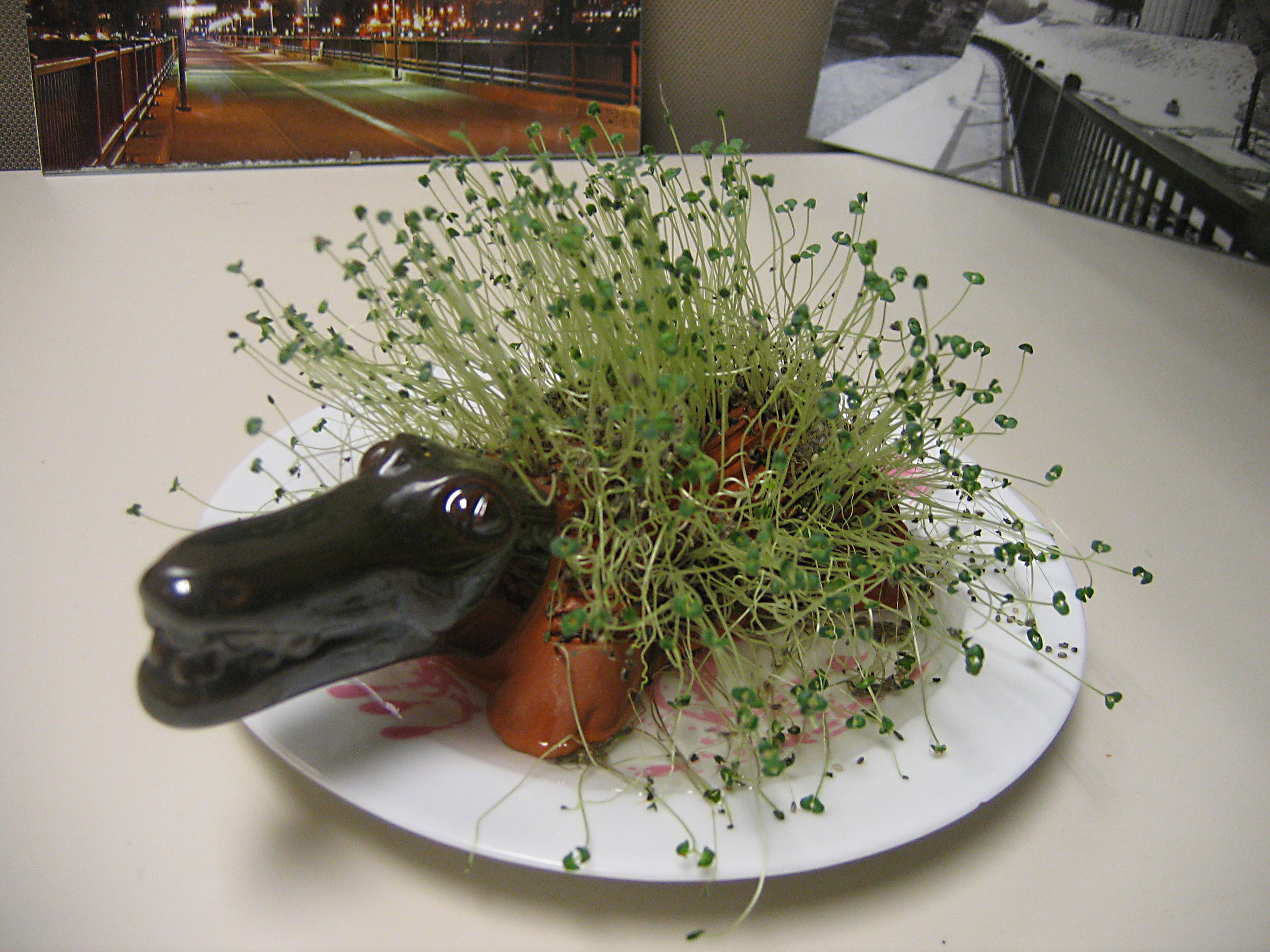
Ch-ch-ch-chia!  Lately, eating chia seeds has been all the rage.  But for those of us of a certain age, all we knew about them was Chia Pets (as seen on TV).  Slightly more fun than a Pet Rock (perhaps), a Chia Pet is a terra cotta shape that you soak in water and slather in chia seeds.  When the seeds sprout, your Chia Pet grows fur.  (I don’t know what the deal is with the alligator.  Who ever heard of a furry alligator?)

It never occurred to me that you could eat the chia seeds – it would have been like suggesting you could eat Sea Monkeys.

Flash forward a few decades, and suddenly the health food crowd is eating chia seeds (Salvia hispanica).

Touted as a “super food” by some, chia seeds are relatively high in protein and omega-3 and omega-6 fatty acids.  Many claims have been made regarding possible health benefits of chia seeds but, since this blog is for informational purposes only and I am not a healthcare professional, I leave it to you to do your own research and due diligence.

This article provides an overview, and is a good place to start.

Not much scientific health research has been done on chia seeds yet.  However, according to one journal article, “the historical use of Salvia hispanica suggests that it is safe for consumption by nonallergic individuals. Further rigorous examination is warranted pertaining to the use of Salvia hispanica as a dietary supplement, as well as in the treatment or prevention of human disease.”

If you are skeptical about the health claims being put forth in the popular media about chia seeds, and you want more scientific information, this blog post is just the thing for you.

My Experience: I read that chia seeds grew slimy* when they were reconstituting, and I thought the texture might be gag-inducing off-putting.  (*Apparently the less unappetizing adjective is “gelatinous”.)

In fact, “Chia seeds have the ability to absorb up to 27 times their weight in water,” according to Dr. Rebecca Rawl, from Carolinas Medical Center in Charlotte, N.C.

The articles I read suggested that the easiest way to start eating chia seeds was to mix the chia seeds into something where they could absorb moisture but the texture wouldn’t be noticeable, like yogurt.  So that is how I began eating chia seeds – mixed into yogurt.

To me, chia seeds don’t have a noticeable flavor.  But if they haven’t fully reconstituted they are a bit crunchy, which is fine, as long as you’re expecting it (yogurt, for example, doesn’t typically crunch).  So, if you want them to get good and slimy gelatinous, you have to give them a few minutes to soak up moisture from whatever you’ve mixed them into (or pre-mix them with water).

I currently mix them into a 6 ounce glass of low-sodium V-8 juice (which I season with Tabasco sauce), and wait for them to reconstitute before I drink it.  [Stir well – they tend to clump on the bottom of the glass!]

I have found that I don’t mind the consistency of the reconstituted chia seeds – it reminds me of tapioca pearls.  But a few always get caught in my teeth at the gum line.  So check your teeth before you leave the house…

“Why are you eating this slimy, disgusting seed?,” you might ask.

Good question.

To put it delicately, chia seeds help keep you regular.

Chia seeds are high in fiber*, and the gelatinous coating around the seeds helps them ease through your digestive system.  *“Just 1 tablespoon of chia seeds will give you 19% of your recommended daily fiber.”  It also helps your stool to be “fluffier,” if that makes any sense to you.

In other words:

“Chia seeds are a good source of insoluble fiber. The seeds expand quite a bit and form a gel when they come into contact with water. This gel adds bulk to your stool, which keeps bowel movements regular and helps prevent constipation.”

Certain medications, like iron supplements or opioid painkillers, cause constipation as a side effect.  Eating chia seeds helps counteract that effect.  Instead of getting dense and compacted, your stool stays more liquid and continues to move through your system.

It’s up to you whether you decide to take them daily, as preventative maintenance for your digestive system, or whether you choose to use them on an “as needed” basis.  They do seem to act relatively quickly, so you don’t have to wait days for the effects.

If you happen to keep an eye on your stool, you can make adjustments as necessary.

“Bottom” line: Many health claims have been made about the benefits of eating chia seeds.  Most of them have not been substantiated by scientific research (although much research remains to be done).  I use chia seeds as a natural means of maintaining regular bowel movements.  They contain only one ingredient, they’re easy to add to my regular diet, and they counteract the constipating effects of some prescription medicines and supplements.

But chia seeds are not for everyone.  See cautions below.

CAUTION:  WebMD lists several possible side effects of consuming chia seeds.  If you have one of these conditions, consult with your health care provider before consuming large or frequent quantities of chia seeds.  

CAUTION:  Some people are allergic to chia seeds.  These individuals should not consume chia seeds.  If you are allergic to sesame seeds or mustard seeds, you may also be allergic to chia seeds.

CAUTION: “If you plan to consume chia seeds or chia seed oil on a regular basis, talk with your doctor. Chia seeds can thin your blood and may affect how medicines such as Coumadin (warfarin) and aspirin work. You may need to avoid chia seeds before surgery.”

CAUTION: Although you can eat chia seeds wet or dry, it is not recommended that you eat a bunch of dry chia seeds and then drink a glass of water.  If you do this, it is possible to have problems with chia seeds lodging in your throat.  People with a history of swallowing problems or esophageal strictures are cautioned to only eat chia seeds after the seeds have fully expanded (same source as previous link).

CAUTION: It is recommended that you not consume more than 3 tablespoons of chia seeds at a time, as this can cause you to visit the bathroom more frequently than you might desire.  According to one source,  the recommended dose for children ages 4 1/2 – 18 is 1 tablespoon per day, although research has not yet established optimal or maximum doses for any age.

NOTE: For an overview of scientific research conducted on the health benefits/side effects of chia seeds, see here.

NOTE:  Nowhere have I found clarification as to whether the suggested doses (in tablespoons)  refers to the dry seeds or the reconstituted (wet) seeds.  I measure approximately 1 1/2 tablespoons of dry seeds into my food or drink and wait for them to reconstitute before consuming them.

Medical Procedures: What It’s Like to Have a Steroid Injection

Approximately six weeks after hand and wrist surgery, I developed “trigger finger” in the pinky finger of my surgery hand.  After the splints were removed and I started using my fingers again, I noticed my pinky finger “clunked” when I curled it, and it “clunked” upon full extension too.

Trigger finger (medical name: stenosing tenosynovitis) happens when inflammation occurs in the sheath surrounding a finger’s tendon, narrowing the space through which the tendon moves and impinging its movement.

After two weeks of occupational therapy and treatment for the swelling in my hand and wrist (eight weeks post-surgery), the clunking in my finger had gotten worse.  So the therapist informed the surgeon, and he decided to treat the trigger finger with a steroid injection.  This was not fun.

My orthopedic surgeon cleaned the injection site thoroughly with an alcohol wipe and then he sprayed an icy numbing spray on the area.  I felt the needle go in.  But the discomfort started as he began to inject the steroid solution.  It felt very similar to an arthrogram injection – there is increasing discomfort as the space begins to fill.  In the case of an arthrogram contrasting solution injection, your joint fills with fluid.  In the case of this steroid injection, my tendon sheath filled with fluid.

As the discomfort increased, I once again found breathing exercises very helpful for controlling the discomfort (for more on breathing exercises, see this previous post).  Additionally, my surgeon was applying pressure to the tip of my finger which helped focus my attention away from the discomfort at the injection site near the base of my finger.

About halfway through the process of filling the tendon sheath with the steroid solution there was a noticeable “clunk”.  Both the surgeon and I could feel it.  He asked me if I felt it, then grinned and said “That’s a good sign.  We’re getting the solution where we want it.”

Toward the end of the injection there was a second “clunk”.  My surgeon was very pleased.  As he continued the injection, he asked if it felt to me like the area was getting too full.  When I said no, he finished emptying the syringe, removed the needle, and placed a band-aid over the injection site.

My surgeon warned me that it would probably hurt the next day – possibly a great deal.  He mentioned that I might find myself saying very uncomplimentary things about him.

[As it turned out, I had no pain or discomfort the next day.  I don’t know if it made a difference that I was wearing a compression glove, a compression stocking, and a brace on that hand.]

My occupational therapist cautioned me not to do my therapeutic exercises for the remainder of the day, as that could cause the steroid solution to work its way out of the target area.  She also told me not to apply heat to the area for the remainder of the day, but said that I could ice it as desired.

For several days following the injection, I am supposed to modify my therapeutic exercises to exclude my pinky finger as much as possible.  My surgeon said it can take up to five days to achieve the full effect.  The steroid injection should reduce the inflammation and allow the affected tendon to move freely again.

I did notice the temporary side effect of facial flushing, but it didn’t last very long (maybe 20-30 minutes).  My finger was also swollen and numb after the injection.  I’m not sure how long that lasted, because I went home immediately and applied a cold pack to the area.  By the time I removed the cold pack, the numbness was gone and most of the swelling was too.

In theory, the steroid injection will relieve the inflammation and cure the trigger finger.  Meanwhile, the rest of the post-surgery swelling of the hand and wrist should gradually abate and hopefully the trigger finger condition will not return.  In other words, hopefully this one treatment will fix it and I shouldn’t need another steroid injection.

Bottom Line: It was pretty uncomfortable during the injection, but I didn’t experience any after-effects.  If this cures my trigger finger in one treatment, it will have been totally worth the temporary discomfort.  As far as medical procedures go, for me, this one was no big deal.

Where Do You Get Your Health Information?

Previously, I spoke about becoming a critical consumer of health information. Today I read an article at U.S. News that adds another element to the discussion – the element of celebrity health advice.

As the article points out, most celebrities are not medically trained, nor are they experts in health science.  Neither are we.  So we often listen to celebrities because we are familiar with them, and they’re good at getting their message across.

Sometimes, we don’t even know where the health information we’re hearing originated from.  A friend tells us.  Then we hear it from our mail carrier, barista, or barber.  If we hear the same health advice from many acquaintances, we start to believe it.  But that doesn’t mean it’s true (or scientifically proven).

I am beginning to read more frequently the argument that scientists and health experts are not as good at getting their health information out to the public as celebrities and other sources are.  I tend to agree that they could be much better at this.

In the Information Age, the traditional academic and scientific methods of distributing information are too slow and too narrowly distributed.  If they do not improve, they will be seen more and more as irrelevant, and the public will get their information elsewhere (as we are already seeing).

Please read this article about celebrity health advice, and why we tend to believe it even though we probably shouldn’t.  Hopefully it will make you more aware of where your health advice comes from, and it will encourage you to get your health information from expert sources such as the NIH, the CDC, the Mayo Clinic, Johns Hopkins, or other academic and scientific sources.

After all, if you get health information from academic and scientific sources, controlled experiments have already been safely conducted on other people.  If you follow health advice from unproven sources, you’re conducting uncontrolled experiments on yourself.

Here’s to your health,

Crew Dog

Status Update

ALCON: The Botox has worn off, and I have two more weeks until the next treatment.  I’m back to spending my days strung out on the couch.  Blog posts will most likely be scarce for the next few weeks.

Guest Post: Diet Decision Making when Tired

[Here’s the next post in the series of guest posts on healthy diet and lifestyle from Dave Banko.]

One of the interesting experiments performed on ‘What’s the Right Diet for You?‘ assessed the effect of being tired on the decisions you make about what to eat.

The participants were divided into 2 groups: one group was given a good night’s rest and the other was forced to stay up until early in the morning. The next morning, both were sent shopping and given identical lists of types of things to purchase, but not given specific items.

When the groups finished shopping, their shopping baskets were compared and the results were astounding! The well rested group made excellent choices: lots of fresh fruits and veg, whole foods, and lean meats. The tired group purchased a lot of sugary and high fat items with a calorie content more than double the amount of the rested group!

Why is this?

When we are tired and drained of energy, our natural preservation mechanism is to quickly boost our energy levels, so we crave sugary and fatty foods.

Making good choices in this state will take every ounce of will power to overcome this fundamental self-preservation instinct.

This also relates to the discussion in my previous blog post about how when we are drained after exercise we crave sugary and fatty foods, but eating them would wipe out the positive weight loss effects of the exercise.

How do we counteract this? First and foremost is to get enough rest. I’ll be writing another post about the additional benefits of a good night’s sleep, and this is certainly one of them.

We live busy lifestyles though, and can’t always get enough rest or do things when well rested. In this case, the best thing to do is make a plan while rested. If grocery shopping, make your list in advance while rested, then stick to it when shopping!

In the end, knowledge is power. Just knowing what our bodies want helps us to make better, healthy lifestyle decisions!

As always, please contact me at daveb.uk@hotmail.com if you have any questions or comments. 🙂  [Crew Dog: Or comment below.]

Guest Post: Hydration and Weight Loss

[Here’s the next post in the guest post series on healthy diet and lifestyle from Dave Banko.]

There is a lot of content available regarding the importance to weight loss of drinking plenty of fluids. I’m including this blog post for completeness, but won’t really spend a lot of time on it.

Below is a great diagram from a post called 11 Reasons Why Dehydration is Making You Fat and Sick.

Just remember to be drinking the right kinds of fluids: plenty of water (perhaps with a squeeze of lemon or other fruit/veg infusion) and green/herbal/fruit teas and limit or eliminate sugary and/or caffeinated drinks. Check the labels and you’ll be surprised how many drinks contain sugar, fructose, and a chemical sweetener.

Please contact me at daveb.uk@hotmail.com with any questions or comments.  [Crew Dog: Or comment below]

[Crew Dog NOTE: For more information on proper hydration, such as getting water from foods, times when you need to increase your fluid intake, and what can happen if you drink too much water (hyponatremia), see this Mayo Clinic post.]

Book Review: The Simple Path to Wealth

SPW cover finalAs a certain TV show used to say, “And now for something *completely* different!”  Not only is this the first book review on this blog, but the book is about Money, not Health.

Rest assured, there is a method to my madness (at least, that’s what I tell Spousal Unit).  Money is related to heath directly, such as when you can’t afford the healthcare you need, and indirectly.  Indirect effects of money on health include the physical and emotional stress that comes from not having enough money to meet your needs, and the strain money problems can have on your relationships.

Therefore, I decided when I was a young lieutenant that understanding the world of finance and mastering my money was a critical life skill.

I started reading personal finance books in the early 90s: Your Money or Your Life, The Wealthy Barber, The Millionaire Next Door, The Tightwad Gazette, and the Bible of personal finance: Making the Most of Your Money, by Jane Bryant Quinn.  Over the years, I put what I learned into practice.  I started saving and investing.  I tried to fight the impulses to buy (too many) cool toys, and the peer pressure to live an affluent (some might say hedonistic) lifestyle.  I made a few mistakes, and I got smarter.  I kept reading books and articles about personal finance.  And then the internet happened.

In 2011, I started reading a personal finance blogMr. Money Mustache. That lead to other personal finance blogs: Early Retirement Extreme, The Military Guide, Get Rich SlowlymadFIentist, The Military Wallet, Root of Good, and many more.

And I noticed this guy, jlcollinsnh, in the comments section of many of these blogs. He was making comments that were insightful, with a wry sense of humor. I followed him back to his blog, jlcollinsnh, and I’ve been reading it ever since. In fact, it is my favorite personal finance blog (no offense, Nords!).

At the same time, and even prior to reading personal finance blogs, I was reading blogs about Simplicity and Minimalism.

I remember thinking, “If only there were a way to simplify personal finance”…

“Why can’t there be a simpler way to invest than holding a diversified portfolio of growth and value stocks, small-cap, mid-cap, large-cap, international, and sector stocks, short-term bonds, intermediate-term bonds, long-term bonds, and cash, spread across retirement and non-retirement accounts?”

JL Collins provided the answer: There *is* a simpler way to invest.

**Financial Independence is not incompatible with Simplicity.**

JL Collins gave me my financial freedom: I didn’t have to worry about asset allocation (Is this blended fund more growth or value? Do I have the right percentage of each asset class?). In fact, he blew my mind when he advised his daughter that she’d do quite well financially if all she ever did was live within her means and invest in just one fund. ONE fund??? Inconceivable!

But what I like best about JL is that he backs up his assertions with logic and data.

He “shows his work.” He doesn’t ask his readers to take his word for it. He explains how he reached his conclusions, and he welcomes challenges because he knows he’s not infallible and he just might learn something. He’s not the Oracle; he’s just a smart guy with a knack for explaining personal finance in a very accessible way, and he’s interested in having conversations with like-minded folks so that everyone can learn from each other and get smarter about our money.

That’s why I did a happy dance when I heard JL Collins was releasing his first book, The Simple Path to Wealth.  [Disclaimer: I was sent an advanced copy of the manuscript in exchange for my honest review.  JL doesn’t hustle his readers, and I don’t either.]

To be honest, I think it’s very difficult for authors to transition from a column/blog post format to a book format.

I loved Dave Barry’s newspaper columns, but was disappointed by a few of his books (although others were brilliant). I was slightly disappointed by Jenny Lawson (aka The Bloggess)’s first book, but feel she really hit her stride with her second book.  (Read it.  She talks candidly but humorously about health issues, including depression.)  I will admit I felt that slight prickle of disappointment initially with JL Collin’s book, The Simple Path to Wealth, as well.

The first section (Part One) felt a bit meandering – not the usual tight, crisp prose I’m accustomed to on his blog. But perhaps this is because I am already well-acquainted with the financial fundamentals and philosophy he outlines in this section. If you are still learning the basics, and the whys and wherefores of personal finance, you may benefit from Part One much more than I did.

However, Part Two is classic Collins: the clear, no-nonsense financial advice that I recommend to others, because it is easy to understand and will get them to where they (presumably) want to be – Financial Independence. And it will get them there with a minimum of hassle.

Collins speaks with the wisdom of someone who has spent a great deal of time thinking about personal finance, and has learned some lessons through trial-and-error. And he shares his hard-won wisdom so that, if you will listen, you can avoid his mistakes.

Furthermore, he understands that most people want to save for retirement, but don’t want to (or are so busy they cannot) spend a bunch of time figuring out how to do it. In Jim’s words, “Financial geeks like me are the aberration. Sane people don’t want to be bothered. My daughter helped me understand this at about the same time I was finally understanding that the most effective investing is also the simplest” (p.111).

Collins continues, “Complex and expensive investments are not only unnecessary, they underperform. Fiddling with your investments almost always leads to worse results. Making a few sound choices and letting them run is the essence of success, and the soul of The Simple Path to Wealth” (p.111).

Read that again: “Making a few sound choices and letting them run is the essence of success, and the soul of The Simple Path to Wealth.”

You can simplify your life by simplifying your investments (including retirement accounts), and you’ll probably reach financial independence sooner than your peers with complicated investment strategies who spend a great deal of time, effort, and emotion fiddling with their finances.

Also in Part Two, Collins is one of the only non-military personal finance educators to actually cover the Thrift Savings Plan (TSP) in his discussion of retirement accounts.  He highlights the often-overlooked consideration that TSPs *not* be rolled over to IRAs after separation from the military/civil service because the fees are so low – often lower than industry-leader Vanguard’s IRA fund fees.

He also includes a case study in Part Two.  Case studies are always fun because you get to see the practical application of the theoretical.  In other words, what does this advice translate to in real life?  Go to Chapter 22 to find out.

Part Three contains more whys and wherefores.  In Part Three, Mr. Collins discusses several hot topics and “shows his work”.

Finally, Part Four of The Simple Path to Wealth talks about what to do once you’ve reached financial independence.  Many talk about how to save and invest to reach retirement/financial independence, but few explain what to do once you get there.  This section talks about the nuts and bolts in such a way that you will feel confident you know what to do once you’ve “arrived”.

Afterword: Chapter 33 contains JL Collins’ blueprint for financial independence.

The Big Idea: “Over the years I’ve come across any number of people embracing life on their own terms.  They are intent on breaking the shackles of debt, consumerism and limiting mindsets, and living free. They are filled with ideas and courage.  This freedom, to me, is the single most valuable thing money can buy and it’s why I offer you the strategies in this book” (p.138).

[NOTE: This book is written for a general audience, not a military one.  For military-specific financial advice, see these blogs: The Military Guide and The Military Wallet.  And this book: The Military Guide to Financial Independence and Retirement.  These resources discuss topics such as military pensions, SBP, TSP, VGLI, and many other military finance alphabet soup words.  However, the basic information and the advice in The Simple Path to Wealth still apply to a military audience.]

Bottom Line: The Simple Path to Wealth is exactly what I hoped it would be: a solid financial reference book that I can confidently recommend to people who want to learn a simple, but effective, way to manage their money and to progress toward financial independence. I like the website, www.jlcollinsnh.com, because I still learn useful things about personal finance, despite having decades of experience. This is true of JL Collins’ book, The Simple Path to Wealth, as well.

Read this book.  Get smart about your money.  “Remember that nobody will care for your money better than you” (p.101).  The Simple Path to Wealth will show you how to manage your money simply and effectively.

Health Hack: Travel First Aid Kit

When I was much younger, I travelled the world without a care.  I took for granted that I would always be healthy.  Then came the time that I got food poisoning (salmonella) on a trip.  I had no first aid kit with me, and I didn’t know how to get medications in another country.

I had a two-day layover in the UK and no way to get even an aspirin – the hotel staff said it was illegal for them to give me any, not that they had any in the hotel.  After a very miserable 48 hours (plus the interminable flight home), I decided to start taking some over-the-counter medications with me when I travel.

The list of remedies I pack has grown with subsequent experiences (an epic hangover in Russia led to the inclusion of an antacid, for example).

My travel first aid supplies currently include:

  • A pain reliever/fever reducer (aspirin/Tylenol)
  • A non-steroidal anti-inflammatory (NSAID; such as Ibuprofen/Alleve)
  • An antacid (Pepcid/Rolaids/Tums)
  • An anti-diarrheal (Imodium)
  • upset stomach medicine (Pepto-Bismol)
  • sleep aid/jet-lag remedy (Melatonin)
  • decongestant/expectorant
  • cough/sore throat lozenges (Cepacol)
  • a travel thermometer
  • tweezers
  • alcohol swabs
  • band aids

You could also include an anti-histamine (Benadryl).  [Update: having had my first allergic reaction, I am adding Benadryl to my kit.]

If you know you will be walking or hiking a lot, you might also want moleskin and an ace bandage.  Depending on local conditions, you may also want to include some travel toilet paper (think MRE TP, but commercially available).

[NOTE: Brand names are included for familiarity.  I buy bargain-sized generic versions of these drugs whenever possible.]

[NOTE: When possible, I buy these drugs in blister packs.  I can take a few sheets of the blister packs with me, instead of an entire bottle, to save weight in my bags.]

[NOTE: I don’t include polysporin because of TSA liquid/gel restrictions.  Soap and water and alcohol swabs are usually sufficient.  You can include polysporin if you place it with your other liquids for screening, and if the container is 3 ounces or less.]

[CAUTION: Do not mix aspirin and NSAIDs.  It can cause stomach ulcers or other problems.]

[CAUTION: Medications which are over-the-counter (uncontrolled) at home may not be uncontrolled in other countries.  For example, Melatonin is only available by prescription in Australia.]

In addition to my travel first aid kit, I always take a bottle of Afrin nasal decongestant spray with me when I fly.

It is a very bad idea to fly with a head cold, but sometimes you don’t realize you’re coming down with a cold until you have trouble clearing your ears on descent.  Afrin can help relieve congestion, which should make it possible for you to clear your ears (equalize the pressure).  If you cannot equalize the pressure, you could rupture an eardrum.  This is why I always carry a bottle of Afrin in my carry-on luggage, just in case.

Even better than having remedies with you when you travel is to avoid needing them in the first place.

I will talk about ways to maintain your health while traveling in another post.

[DISCLAIMER: All information is provided for educational purposes only.  I am not a trained healthcare provider or medical expert.  Use common sense, know what works for your body, and if you have any questions, consult with your healthcare provider.  Many medications, including over-the-counter medications, are contraindicated for patients with specific health conditions.  Do not take a medication if it is unsafe for you or may aggravate other health conditions you have.]

CALL TO ACTION: If you currently do not travel with a first aid kit or over-the-counter remedies, I encourage you to assemble a kit before your next trip, TDY, or deployment.  You don’t need a fancy container – I keep mine in my toiletries bag.

What do you pack in your travel first aid kit?